
How Much Does it Cost to Run an Air Source Heat Pump? Average Bills and Tips
Understanding Your Heat Pump Energy Bills We’re often asked: “What should my electricity bills be?”Honestly, that’s almost impossible to answer—it’s a bit like asking: “How much will my car cost to run?” It depends on so many things: how warm you like your home, how much hot water you use, the size of your house, and…

Why you can trust our content
We know the plumbing and renewable energy industry can feel overwhelming, especially with conflicting advice and outdated information online. That’s why we base everything we do on clarity, expertise, and trusted sources:



At a glance
Understanding Your Heat Pump Energy Bills
We’re often asked: “What should my electricity bills be?”
Honestly, that’s almost impossible to answer—it’s a bit like asking: “How much will my car cost to run?” It depends on so many things: how warm you like your home, how much hot water you use, the size of your house, and of course, the Scottish weather. But here’s the good news: what we can do is help you run your heat pump in the best possible way, so you’re comfortable and your bills stay under control.
Why Your Bills Look Different following a Heat Pump Installation
- One bill instead of two – if you used to pay for oil, LPG, or gas, that’s now all rolled into your electricity. So yes, your electricity bill will look higher, but you’re no longer paying for another fuel.
- Seasonal swings – heat pumps work hardest in winter, so bills are naturally higher then. 70% of your heating bill costs are likely to be from November – February. The best way to avoid “bill shock” is to spread the cost evenly over the year with monthly direct debit payments.
- If your heat pump was installed during winter, your first few bills will be higher until spring kicks in.
A Quick Word on Efficiency (COP)
Your heat pump’s efficiency is measured by something called COP (Coefficient of Performance).
- A COP of 3 means you get 3 units of heat for every 1 unit of electricity.
- In Scotland, you can usually expect:
- Spring/Autumn: COP around 3.5 – 4.5
- Cold winter days: COP around 2.5 – 3.5
- Yearly average (SCOP): about 3 or better
Think of COP like “miles per gallon” for your heating. It changes with the weather, but over the year, your system should give you between three – four times the heat for the power it uses.
Monitoring Your Heat Pump’s Efficiency
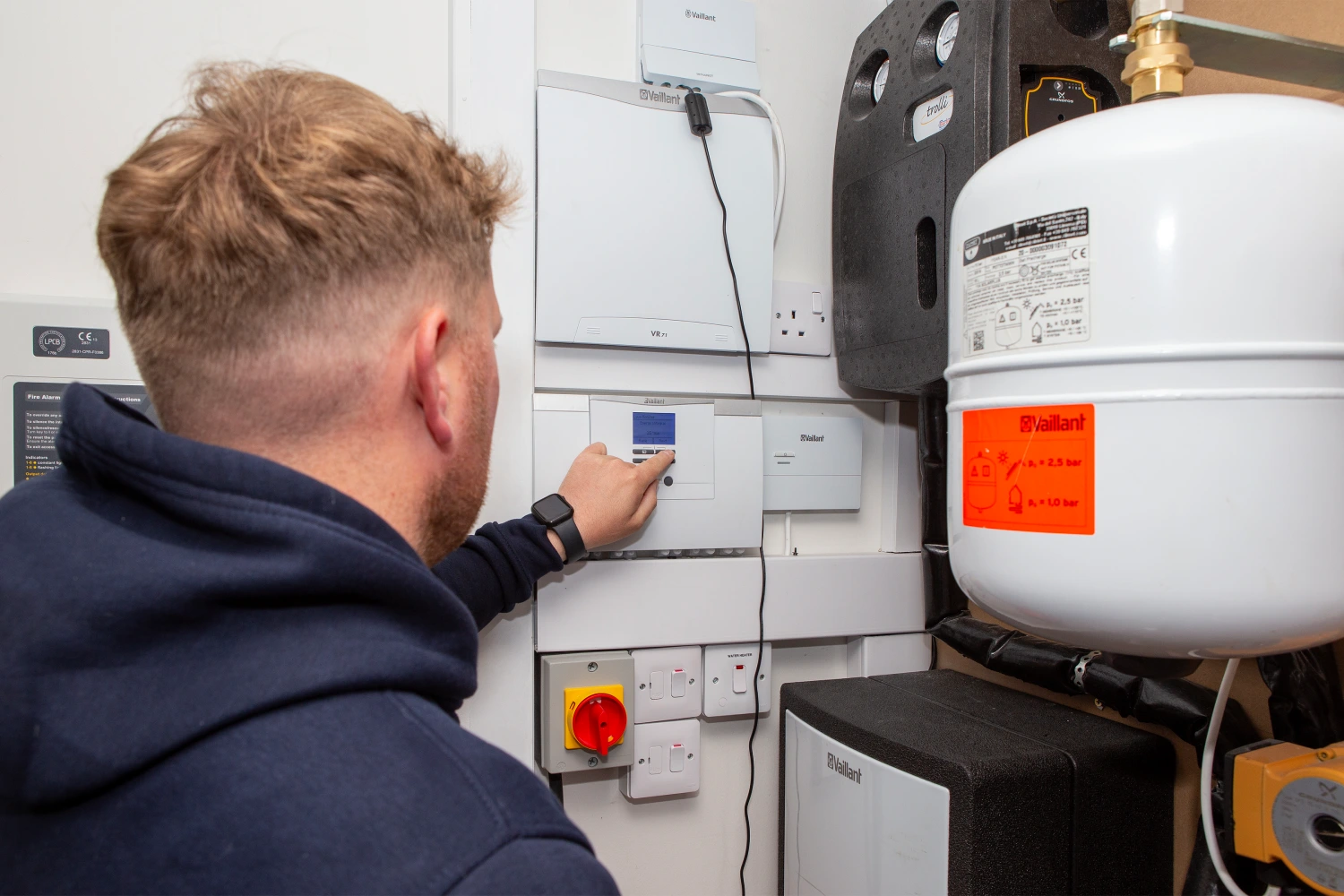
Many of the heat pumps we install let you see exactly how efficiently they’re running, often through a convenient app. You can check your system’s performance in real time:
- Mitsubishi: Melcloud
- Vaillant: MyVaillant App
- Grant Aerona: Econet
- Samsung: Efficiency can be calculated using your main controller
All of these systems provide clear, easy-to-read displays. There are also instruction booklets and helpful YouTube videos if you’d like guidance.
If you’d like more detailed information for your specific heat pump model, just let us know, we’ll be happy to send it to you.
Tips for Running Your Heat Pump Efficiently
- Long and Low – Gentle, Steady Heating Works Best
Heat pumps are most efficient when running continuously at a moderate pace. Short, intense bursts increase electricity use. Steady heating maintains comfort while maximising efficiency. Think of it like simmering water instead of rapidly boiling it. - Set and Forget – Avoid Big Swings in Thermostat Settings
Constantly turning the thermostat up and down reduces efficiency. Keep a consistent, comfortable temperature. Minor night setbacks (1–2°C) are fine, but don’t expect big savings if the system has to heat the house back up in the morning. - Lower Flow Temperatures = Better COP
Heat pumps are more efficient at lower flow temperatures. Lukewarm radiators are effective if your system is designed properly. Balancing comfort and efficiency is key, you want your radiators as cool as possible whilst still maintaining room comfort. If you’re unsure about adjusting flow temps yourself, we can help during your annual service. - Check Your Tariff – Off-Peak or Heat Pump-Specific Rates
Many suppliers offer heat pump or off-peak tariffs, which can save hundreds per year. Examples include OVO Heat Pump Plus or Octopus Cosy. Running your heat pump during cheaper periods lower costs without affecting comfort. - Managing Multiple Thermostats for Better Efficiency
Underfloor heating often uses multiple thermostats, but these can cause your heat pump to start and stop frequently, reducing efficiency. Simple tweaks can minimise unnecessary stops and save energy. We can review your system if needed. - Keep It Serviced – Annual Maintenance Matters
Regular servicing keeps your heat pump efficient and reliable. Small issues caught early are far cheaper than major repairs and help prolong your system’s lifespan. - Seriously Slash your Bills – Add Solar Panels and Battery Storage
Pairing your heat pump with solar panels and a battery can really slash your bills. It requires upfront investment, but it can dramatically lower monthly running costs. Contact us for advice and quotations.
Real-Life Examples from Our Own Homes (Updated October 2025)
We know it helps to see real numbers, not just theory. Here are some examples from our own team, so you can see what living with a heat pump (and sometimes solar, batteries and electric vehicle charging too) really looks like.
Nathan & Reanne – Elgin, 3-bed home (100 years old, renovated & extended)
- Tech: 5kW Vaillant Heat Pump, 5.3kW Solar Panels, 9kW Battery
- Tariffs: Octopus Cosy & Octopus Outgoing (Outgoing pays for the extra solar energy sent back to the grid)
- Annual Bills: £650 (£55/month)
- Our Tip: “We spread the cost on direct debit. Having solar and a battery has been brilliant—we actually go into credit in summer. For months at a time, we don’t use any energy from the grid at all!”
Heidi – Burghead, 4-bed home (23 years old)
- Tech: Mitsubishi Ecodan 8kW Heat Pump
- Tariff: Scottish Power Variable Rate
- Annual Bills: £1,750 (£145/month)
- My Tip: “Once the house is up to temperature, we just keep it there. We tried turning it down overnight but it didn’t work for us—the pump just had to work harder in the morning. For us, steady was better. We are going to switch to a heat pump tariff for this year, and see if we can get our bills down a bit. ”
Barry – Forres, 4-bed home (10 years old)
- Tech: 7kW Vaillant aroTHERM Plus Heat Pump, 5kW Solar Panels, 10kW Battery, EV Charger
- Tariffs: Octopus Intelligent Go & Octopus Outgoing
- Annual Bills: £700 (£59/month)
- My Tip: “I use the cheap overnight tariff to charge the car, heat the hot water, and top up the battery in winter. That way, our bills stay really low—even with 12,000 miles of car charging”
Mark & Jill – Burghead, 5-bed home (170 years old, main living areas insulated)
- Tech: 10kW Vaillant aroTHERM Plus, 16kW Give Energy Storage Batteries, EV Charger
- Tariff: Octopus Intelligent Go
- Annual Bills: £2,800 (£240/month), including 30,000 EV charging miles annually.
- Our Tip: “We do a lot of car charging, so without that our bills would be closer to £150/month. My biggest advice on our tariff, to use the cheap overnight electricity for everything you can—car charging, hot water, battery charging. And if you’ve got teenagers, don’t underestimate how much the showers add up, honestly, my top tip is to shout at the kids to get out of the shower!”
The Bottom Line
No two households are the same. But what we see again and again is that heat pumps don’t mean high bills, especially if you follow the efficiency tips above. And if you add solar and batteries into the mix, the savings can be huge.
If you’d like to chat about getting more from your heat pump, or adding solar and storage, just ask, we’re always happy to share our own experiences.
Related articles

Which option best describes your home?
At a glance
Understanding Your Heat Pump Energy Bills
We’re often asked: “What should my electricity bills be?”
Honestly, that’s almost impossible to answer—it’s a bit like asking: “How much will my car cost to run?” It depends on so many things: how warm you like your home, how much hot water you use, the size of your house, and of course, the Scottish weather. But here’s the good news: what we can do is help you run your heat pump in the best possible way, so you’re comfortable and your bills stay under control.
Why Your Bills Look Different following a Heat Pump Installation
- One bill instead of two – if you used to pay for oil, LPG, or gas, that’s now all rolled into your electricity. So yes, your electricity bill will look higher, but you’re no longer paying for another fuel.
- Seasonal swings – heat pumps work hardest in winter, so bills are naturally higher then. 70% of your heating bill costs are likely to be from November – February. The best way to avoid “bill shock” is to spread the cost evenly over the year with monthly direct debit payments.
- If your heat pump was installed during winter, your first few bills will be higher until spring kicks in.
A Quick Word on Efficiency (COP)
Your heat pump’s efficiency is measured by something called COP (Coefficient of Performance).
- A COP of 3 means you get 3 units of heat for every 1 unit of electricity.
- In Scotland, you can usually expect:
- Spring/Autumn: COP around 3.5 – 4.5
- Cold winter days: COP around 2.5 – 3.5
- Yearly average (SCOP): about 3 or better
Think of COP like “miles per gallon” for your heating. It changes with the weather, but over the year, your system should give you between three – four times the heat for the power it uses.
Monitoring Your Heat Pump’s Efficiency
Many of the heat pumps we install let you see exactly how efficiently they’re running, often through a convenient app. You can check your system’s performance in real time:
- Mitsubishi: Melcloud
- Vaillant: MyVaillant App
- Grant Aerona: Econet
- Samsung: Efficiency can be calculated using your main controller
All of these systems provide clear, easy-to-read displays. There are also instruction booklets and helpful YouTube videos if you’d like guidance.
If you’d like more detailed information for your specific heat pump model, just let us know, we’ll be happy to send it to you.
Tips for Running Your Heat Pump Efficiently
- Long and Low – Gentle, Steady Heating Works Best
Heat pumps are most efficient when running continuously at a moderate pace. Short, intense bursts increase electricity use. Steady heating maintains comfort while maximising efficiency. Think of it like simmering water instead of rapidly boiling it. - Set and Forget – Avoid Big Swings in Thermostat Settings
Constantly turning the thermostat up and down reduces efficiency. Keep a consistent, comfortable temperature. Minor night setbacks (1–2°C) are fine, but don’t expect big savings if the system has to heat the house back up in the morning. - Lower Flow Temperatures = Better COP
Heat pumps are more efficient at lower flow temperatures. Lukewarm radiators are effective if your system is designed properly. Balancing comfort and efficiency is key, you want your radiators as cool as possible whilst still maintaining room comfort. If you’re unsure about adjusting flow temps yourself, we can help during your annual service. - Check Your Tariff – Off-Peak or Heat Pump-Specific Rates
Many suppliers offer heat pump or off-peak tariffs, which can save hundreds per year. Examples include OVO Heat Pump Plus or Octopus Cosy. Running your heat pump during cheaper periods lower costs without affecting comfort. - Managing Multiple Thermostats for Better Efficiency
Underfloor heating often uses multiple thermostats, but these can cause your heat pump to start and stop frequently, reducing efficiency. Simple tweaks can minimise unnecessary stops and save energy. We can review your system if needed. - Keep It Serviced – Annual Maintenance Matters
Regular servicing keeps your heat pump efficient and reliable. Small issues caught early are far cheaper than major repairs and help prolong your system’s lifespan. - Seriously Slash your Bills – Add Solar Panels and Battery Storage
Pairing your heat pump with solar panels and a battery can really slash your bills. It requires upfront investment, but it can dramatically lower monthly running costs. Contact us for advice and quotations.
Real-Life Examples from Our Own Homes (Updated October 2025)
We know it helps to see real numbers, not just theory. Here are some examples from our own team, so you can see what living with a heat pump (and sometimes solar, batteries and electric vehicle charging too) really looks like.
Nathan & Reanne – Elgin, 3-bed home (100 years old, renovated & extended)
- Tech: 5kW Vaillant Heat Pump, 5.3kW Solar Panels, 9kW Battery
- Tariffs: Octopus Cosy & Octopus Outgoing (Outgoing pays for the extra solar energy sent back to the grid)
- Annual Bills: £650 (£55/month)
- Our Tip: “We spread the cost on direct debit. Having solar and a battery has been brilliant—we actually go into credit in summer. For months at a time, we don’t use any energy from the grid at all!”
Heidi – Burghead, 4-bed home (23 years old)
- Tech: Mitsubishi Ecodan 8kW Heat Pump
- Tariff: Scottish Power Variable Rate
- Annual Bills: £1,750 (£145/month)
- My Tip: “Once the house is up to temperature, we just keep it there. We tried turning it down overnight but it didn’t work for us—the pump just had to work harder in the morning. For us, steady was better. We are going to switch to a heat pump tariff for this year, and see if we can get our bills down a bit. ”
Barry – Forres, 4-bed home (10 years old)
- Tech: 7kW Vaillant aroTHERM Plus Heat Pump, 5kW Solar Panels, 10kW Battery, EV Charger
- Tariffs: Octopus Intelligent Go & Octopus Outgoing
- Annual Bills: £700 (£59/month)
- My Tip: “I use the cheap overnight tariff to charge the car, heat the hot water, and top up the battery in winter. That way, our bills stay really low—even with 12,000 miles of car charging”
Mark & Jill – Burghead, 5-bed home (170 years old, main living areas insulated)
- Tech: 10kW Vaillant aroTHERM Plus, 16kW Give Energy Storage Batteries, EV Charger
- Tariff: Octopus Intelligent Go
- Annual Bills: £2,800 (£240/month), including 30,000 EV charging miles annually.
- Our Tip: “We do a lot of car charging, so without that our bills would be closer to £150/month. My biggest advice on our tariff, to use the cheap overnight electricity for everything you can—car charging, hot water, battery charging. And if you’ve got teenagers, don’t underestimate how much the showers add up, honestly, my top tip is to shout at the kids to get out of the shower!”
The Bottom Line
No two households are the same. But what we see again and again is that heat pumps don’t mean high bills, especially if you follow the efficiency tips above. And if you add solar and batteries into the mix, the savings can be huge.
If you’d like to chat about getting more from your heat pump, or adding solar and storage, just ask, we’re always happy to share our own experiences.