

Choosing Renewable Heating Support That Stays Local After Installation
Choosing a renewable heating system is a long-term decision. The installation itself is important, but what happens afterwards can be just as relevant.

Why you can trust our content
We know the plumbing and renewable energy industry can feel overwhelming, especially with conflicting advice and outdated information online. That’s why we base everything we do on clarity, expertise, and trusted sources:


At a glance
Heat pumps have controls, operating settings, components and maintenance requirements that homeowners may need help understanding over time. Having a clear route to support can make ownership much easier, particularly during the first few months while you become familiar with the system.
For homeowners considering an air source heat pump Elgin installation, it is therefore worth looking beyond the initial quotation and asking what local support will be available after the system has been commissioned.
If you are considering renewable heating for your home, Plumbing & Renewables can explain the installation process, system requirements and support available before you make a decision.
Why does local support matter after a heat pump installation?
A heat pump is not simply installed and forgotten.
Like other heating systems, it may need servicing, adjustments or troubleshooting during its working life. Homeowners may also have questions about controls, heating schedules or system performance.
A local installer can provide a clear point of contact when support is required.
This can be particularly useful if you need someone to understand the original installation rather than having to explain the entire system to a new contractor.
A renewable heating installer Elgin homeowners choose should therefore be able to explain not only how the installation will be completed, but also what happens afterwards.
What should you ask about aftercare before choosing an installer?
Aftercare can mean different things to different installers, so ask specific questions before signing.
Useful questions include:
- Who do I contact if I have a problem?
- Is maintenance available locally?
- Who handles warranty queries?
- Can you help with controls after installation?
- How are faults reported?
- Do you provide follow-up support?
- Will you keep records of the installation?
- What documentation will I receive?
- What maintenance does the manufacturer recommend?
The answers should be clear enough for you to understand what support you can realistically expect.
Does the installer need to understand the original system?
Ideally, yes.
A heat pump installation involves a combination of equipment, pipework, controls and heating emitters. The installer that designed and commissioned the system already has useful information about how those components were selected.
If an issue develops later, having access to the original installation information can make troubleshooting more straightforward.
This is one reason to keep your quotation, commissioning documentation, equipment details and warranty information in a safe place.
What type of maintenance does a heat pump need?
The exact maintenance requirements depend on the system and manufacturer instructions.
Homeowners should understand what routine checks are recommended and which tasks should be completed by a qualified professional.
Possible areas can include:
- Checking system operation
- Inspecting relevant components
- Cleaning or checking filters where applicable
- Checking external areas around the unit
- Reviewing system pressure where relevant
- Checking controls
- Identifying potential faults
- Completing manufacturer-recommended servicing
The homeowner should follow the equipment manufacturer’s guidance rather than assuming that every heat pump has identical maintenance requirements.
How can local support help with controls?
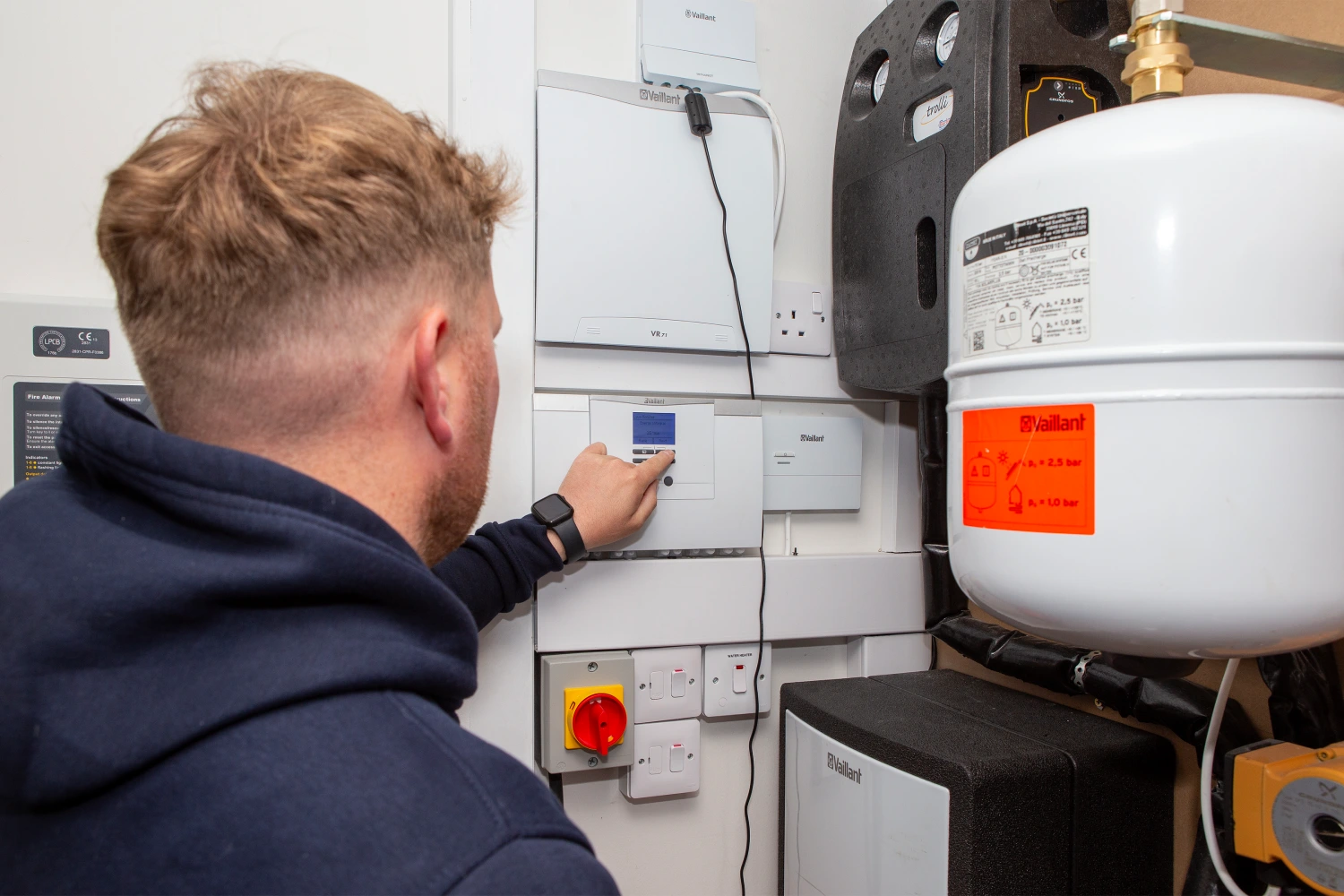
Heat pump controls can work differently from those used with traditional heating systems.
Many systems are designed to operate steadily and efficiently rather than relying on frequent short periods of high-temperature heating.
During the first few weeks, homeowners may need help understanding:
- Heating schedules
- Thermostat settings
- Weather compensation
- Hot water settings
- Temperature adjustments
- Holiday modes
- Energy monitoring
- System alerts
A useful installer should be able to explain the controls during handover and provide further assistance if questions arise later.
If you are planning an air source heat pump Elgin installation and want to understand how the system will work after commissioning, speak to Plumbing & Renewables about the equipment, controls and ongoing support.
Which option best describes your home?
It just takes 2 minutes
And then you can book a free consultation
What happens if a fault develops?
The first step should be to follow the manufacturer’s or installer’s recommended fault-reporting process.
Your installer should be able to explain who handles different types of problems.
For example, some issues may relate to installation workmanship, while others may involve a manufacturer’s component warranty.
Keeping your documentation available can help establish:
- Which model was installed
- When it was installed
- Who installed it
- What warranty applies
- What commissioning was completed
- What maintenance has taken place
Having this information readily available can save time when support is needed.
Why is warranty support part of good aftercare?
A warranty provides protection according to its specific terms, but knowing how to use that protection is also important.
Before installation, establish:
- Equipment warranty duration
- Workmanship cover
- Registration requirements
- Maintenance conditions
- Exclusions
- Claims procedure
- Installer contact details
A local renewable heating installer Elgin homeowners choose should be able to explain the relevant arrangements rather than leaving you to work them out after a problem occurs.
Can local knowledge make a difference?
It can.
Properties in the same broad area can still have very different construction, layouts and heating requirements. An installer familiar with local housing types may have experience working with a range of property characteristics.
However, local presence should not replace technical competence.
The important combination is appropriate certification, good installation practice, property-specific design and reliable support.
Location is valuable because it can make communication and follow-up more practical, but it should be considered alongside the quality of the actual installation.
What should you receive when installation is completed?
A proper handover should leave you with useful information about the system.
Depending on the project, documentation may include:
| Information | Why it matters |
| Equipment details | Identifies the installed system |
| Warranty documents | Explains available protection |
| Commissioning information | Records system setup |
| Operating instructions | Helps you use the controls |
| Maintenance guidance | Explains recommended care |
| Installer details | Provides a contact for support |
| Relevant certification | Documents completed work |
Ask the installer what documentation will be provided before the project begins.
What does good local aftercare look like?
Good aftercare does not necessarily mean unlimited free servicing or permanent availability.
It means there is a clear and realistic support process.
A good installer should make it reasonably clear:
- Who you contact
- When you should contact them
- What information they need
- Whether visits are available
- How warranty issues are handled
- What maintenance is recommended
- What services are available after installation
This gives homeowners a clearer understanding of what the ongoing relationship looks like.
A typical Elgin homeowner example
Imagine a homeowner who has recently replaced an older boiler with an air source heat pump.
The installation has been completed correctly, but the homeowner is unsure why the heating sometimes operates for longer periods than the old boiler did.
Rather than changing settings repeatedly, they contact the installer.
The installer explains how the system has been designed to operate, checks the controls and confirms the appropriate settings.
That small amount of follow-up support can make the homeowner much more comfortable with the new system.
It also demonstrates why choosing an installer should involve considering the period after installation, not simply the day the equipment is fitted.
Should you choose a local installer solely because they are nearby?
No.
Being local is useful, but it is only one part of the decision.
You should also consider:
- Relevant certification
- Experience
- Quality of system design
- Installation standards
- Equipment selection
- Quotation transparency
- Warranty arrangements
- Customer reviews
- Aftercare
A renewable heating installer Elgin homeowners are considering should be able to demonstrate competence as well as local availability.
If you are looking for renewable heating support that covers both installation and the period afterwards, contact Plumbing & Renewables. Our team can discuss your requirements and explain the available options.
Final thoughts
A renewable heating installation should be considered as a long-term relationship rather than a one-day project. The quality of the installation matters, but so does having a clear route to support when you need help with controls, maintenance, warranties or faults.
For homeowners considering an air source heat pump Elgin project, ask potential installers what support is available after commissioning and make sure the arrangements are clear before you proceed.
Plumbing & Renewables provides renewable heating guidance with attention to both the installation and the practical needs of homeowners afterwards. Choosing an installer that can offer clear communication and reliable support can make the transition to renewable heating considerably more straightforward.
Related articles

Which option best describes your home?
At a glance
Heat pumps have controls, operating settings, components and maintenance requirements that homeowners may need help understanding over time. Having a clear route to support can make ownership much easier, particularly during the first few months while you become familiar with the system.
For homeowners considering an air source heat pump Elgin installation, it is therefore worth looking beyond the initial quotation and asking what local support will be available after the system has been commissioned.
If you are considering renewable heating for your home, Plumbing & Renewables can explain the installation process, system requirements and support available before you make a decision.
Why does local support matter after a heat pump installation?
A heat pump is not simply installed and forgotten.
Like other heating systems, it may need servicing, adjustments or troubleshooting during its working life. Homeowners may also have questions about controls, heating schedules or system performance.
A local installer can provide a clear point of contact when support is required.
This can be particularly useful if you need someone to understand the original installation rather than having to explain the entire system to a new contractor.
A renewable heating installer Elgin homeowners choose should therefore be able to explain not only how the installation will be completed, but also what happens afterwards.
What should you ask about aftercare before choosing an installer?
Aftercare can mean different things to different installers, so ask specific questions before signing.
Useful questions include:
- Who do I contact if I have a problem?
- Is maintenance available locally?
- Who handles warranty queries?
- Can you help with controls after installation?
- How are faults reported?
- Do you provide follow-up support?
- Will you keep records of the installation?
- What documentation will I receive?
- What maintenance does the manufacturer recommend?
The answers should be clear enough for you to understand what support you can realistically expect.
Does the installer need to understand the original system?
Ideally, yes.
A heat pump installation involves a combination of equipment, pipework, controls and heating emitters. The installer that designed and commissioned the system already has useful information about how those components were selected.
If an issue develops later, having access to the original installation information can make troubleshooting more straightforward.
This is one reason to keep your quotation, commissioning documentation, equipment details and warranty information in a safe place.
What type of maintenance does a heat pump need?
The exact maintenance requirements depend on the system and manufacturer instructions.
Homeowners should understand what routine checks are recommended and which tasks should be completed by a qualified professional.
Possible areas can include:
- Checking system operation
- Inspecting relevant components
- Cleaning or checking filters where applicable
- Checking external areas around the unit
- Reviewing system pressure where relevant
- Checking controls
- Identifying potential faults
- Completing manufacturer-recommended servicing
The homeowner should follow the equipment manufacturer’s guidance rather than assuming that every heat pump has identical maintenance requirements.
How can local support help with controls?
Heat pump controls can work differently from those used with traditional heating systems.
Many systems are designed to operate steadily and efficiently rather than relying on frequent short periods of high-temperature heating.
During the first few weeks, homeowners may need help understanding:
- Heating schedules
- Thermostat settings
- Weather compensation
- Hot water settings
- Temperature adjustments
- Holiday modes
- Energy monitoring
- System alerts
A useful installer should be able to explain the controls during handover and provide further assistance if questions arise later.
If you are planning an air source heat pump Elgin installation and want to understand how the system will work after commissioning, speak to Plumbing & Renewables about the equipment, controls and ongoing support.
Which option best describes your home?
It just takes 2 minutes
And then you can book a free consultation
What happens if a fault develops?
The first step should be to follow the manufacturer’s or installer’s recommended fault-reporting process.
Your installer should be able to explain who handles different types of problems.
For example, some issues may relate to installation workmanship, while others may involve a manufacturer’s component warranty.
Keeping your documentation available can help establish:
- Which model was installed
- When it was installed
- Who installed it
- What warranty applies
- What commissioning was completed
- What maintenance has taken place
Having this information readily available can save time when support is needed.
Why is warranty support part of good aftercare?
A warranty provides protection according to its specific terms, but knowing how to use that protection is also important.
Before installation, establish:
- Equipment warranty duration
- Workmanship cover
- Registration requirements
- Maintenance conditions
- Exclusions
- Claims procedure
- Installer contact details
A local renewable heating installer Elgin homeowners choose should be able to explain the relevant arrangements rather than leaving you to work them out after a problem occurs.
Can local knowledge make a difference?
It can.
Properties in the same broad area can still have very different construction, layouts and heating requirements. An installer familiar with local housing types may have experience working with a range of property characteristics.
However, local presence should not replace technical competence.
The important combination is appropriate certification, good installation practice, property-specific design and reliable support.
Location is valuable because it can make communication and follow-up more practical, but it should be considered alongside the quality of the actual installation.
What should you receive when installation is completed?
A proper handover should leave you with useful information about the system.
Depending on the project, documentation may include:
| Information | Why it matters |
| Equipment details | Identifies the installed system |
| Warranty documents | Explains available protection |
| Commissioning information | Records system setup |
| Operating instructions | Helps you use the controls |
| Maintenance guidance | Explains recommended care |
| Installer details | Provides a contact for support |
| Relevant certification | Documents completed work |
Ask the installer what documentation will be provided before the project begins.
What does good local aftercare look like?
Good aftercare does not necessarily mean unlimited free servicing or permanent availability.
It means there is a clear and realistic support process.
A good installer should make it reasonably clear:
- Who you contact
- When you should contact them
- What information they need
- Whether visits are available
- How warranty issues are handled
- What maintenance is recommended
- What services are available after installation
This gives homeowners a clearer understanding of what the ongoing relationship looks like.
A typical Elgin homeowner example
Imagine a homeowner who has recently replaced an older boiler with an air source heat pump.
The installation has been completed correctly, but the homeowner is unsure why the heating sometimes operates for longer periods than the old boiler did.
Rather than changing settings repeatedly, they contact the installer.
The installer explains how the system has been designed to operate, checks the controls and confirms the appropriate settings.
That small amount of follow-up support can make the homeowner much more comfortable with the new system.
It also demonstrates why choosing an installer should involve considering the period after installation, not simply the day the equipment is fitted.
Should you choose a local installer solely because they are nearby?
No.
Being local is useful, but it is only one part of the decision.
You should also consider:
- Relevant certification
- Experience
- Quality of system design
- Installation standards
- Equipment selection
- Quotation transparency
- Warranty arrangements
- Customer reviews
- Aftercare
A renewable heating installer Elgin homeowners are considering should be able to demonstrate competence as well as local availability.
If you are looking for renewable heating support that covers both installation and the period afterwards, contact Plumbing & Renewables. Our team can discuss your requirements and explain the available options.
Final thoughts
A renewable heating installation should be considered as a long-term relationship rather than a one-day project. The quality of the installation matters, but so does having a clear route to support when you need help with controls, maintenance, warranties or faults.
For homeowners considering an air source heat pump Elgin project, ask potential installers what support is available after commissioning and make sure the arrangements are clear before you proceed.
Plumbing & Renewables provides renewable heating guidance with attention to both the installation and the practical needs of homeowners afterwards. Choosing an installer that can offer clear communication and reliable support can make the transition to renewable heating considerably more straightforward.


