
How Installers Set Up an Air Source Heat Pump for Real Home Comfort?
An air source heat pump can look relatively simple from the outside, but getting reliable home comfort involves much more than positioning an outdoor unit against a wall.

Why you can trust our content
We know the plumbing and renewable energy industry can feel overwhelming, especially with conflicting advice and outdated information online. That’s why we base everything we do on clarity, expertise, and trusted sources:


At a glance
The system needs to work with the property, existing heating distribution, hot water requirements and controls. Small details in design and setup can influence how evenly the home heats, how the system operates and how straightforward it is to use.
For homeowners considering an air source heat pump Elgin installation, understanding how the system is set up can help explain why a proper property assessment is so important.
If you are considering renewable heating and want to understand how a heat pump could work with your property, contact Plumbing & Renewables for practical, property-specific guidance.
What does a heat pump installer assess before fitting the system?
The setup starts well before installation day.
A suitable installer needs to understand the heating requirements of the property rather than simply choosing a heat pump based on floor area.
The assessment may consider:
- Property size and layout
- Room-by-room heat requirements
- Insulation levels
- Windows and external doors
- Existing radiators
- Pipework
- Hot water demand
- Electrical requirements
- Outdoor unit location
- Available space for indoor equipment
This information helps determine what equipment is appropriate and whether changes to the existing heating system are required.
A heat pump installation specialist should be able to explain the reasoning behind the proposed system rather than simply presenting a standard package.
How is the heat pump sized for the property?
Sizing is one of the most important parts of the design process.
A heat pump needs to provide enough heat to meet the property’s requirements under appropriate conditions. Selecting a system that is too small or poorly matched to the home can create problems with comfort and system operation.
At the same time, simply choosing a larger unit is not automatically better.
The aim is to select equipment that is appropriate for the calculated heating demand and intended operating conditions.
This is why a proper assessment is more useful than relying solely on a generic online calculator or property size.
Why do radiators matter with an air source heat pump?
Existing radiators form part of the overall heating system, so they need to be assessed alongside the proposed heat pump.
Heat pumps generally operate at lower flow temperatures than many traditional boilers. As a result, a radiator that worked well with a high-temperature boiler may not necessarily provide the same heat output under heat pump operating conditions.
Some existing radiators may be perfectly suitable.
Others may need to be upgraded or replaced with larger models.
The important point is that this should be established during the design stage, rather than discovered after installation.
Which option best describes your home?
It just takes 2 minutes
And then you can book a free consultation
How does the outdoor unit contribute to home comfort?
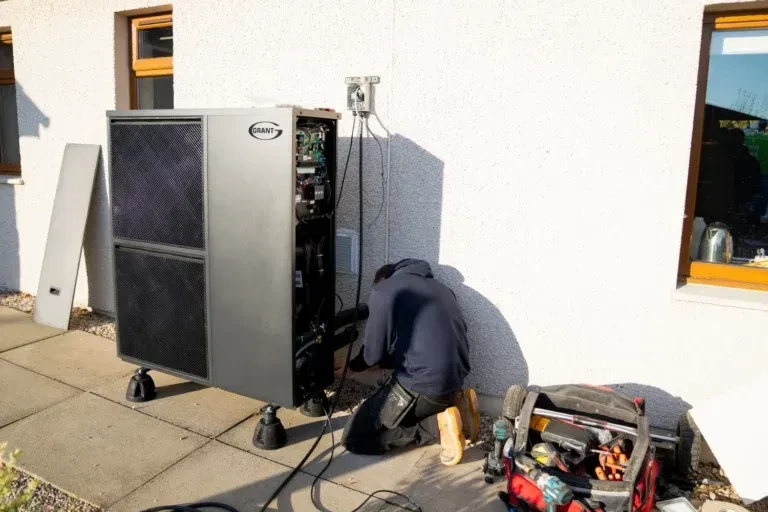
The outdoor unit extracts heat from the surrounding air and transfers it into the home’s heating system.
Its position therefore needs to be carefully considered.
Installers may need to look at:
- Available space
- Airflow around the unit
- Access for maintenance
- Pipework routes
- Electrical connections
- Drainage
- The manufacturer’s installation requirements
The outdoor unit should not simply be placed wherever there happens to be an empty section of wall or garden.
Its location forms part of the wider system design.
What happens to the heat once it enters the home?
The heat pump transfers heat into the home’s heating system, which then distributes it through radiators or other heat emitters.
The overall system can include several connected elements:
| Component | Main purpose |
| Outdoor heat pump | Extracts heat from outdoor air |
| Indoor hydraulic components | Transfer and manage heat within the system |
| Radiators or emitters | Deliver heat into rooms |
| Hot water cylinder | Stores heated domestic hot water |
| Controls | Manage temperatures and operating schedules |
| Pipework | Circulates water between components |
Each component needs to work with the others.
This is why system design matters as much as the individual heat pump model.
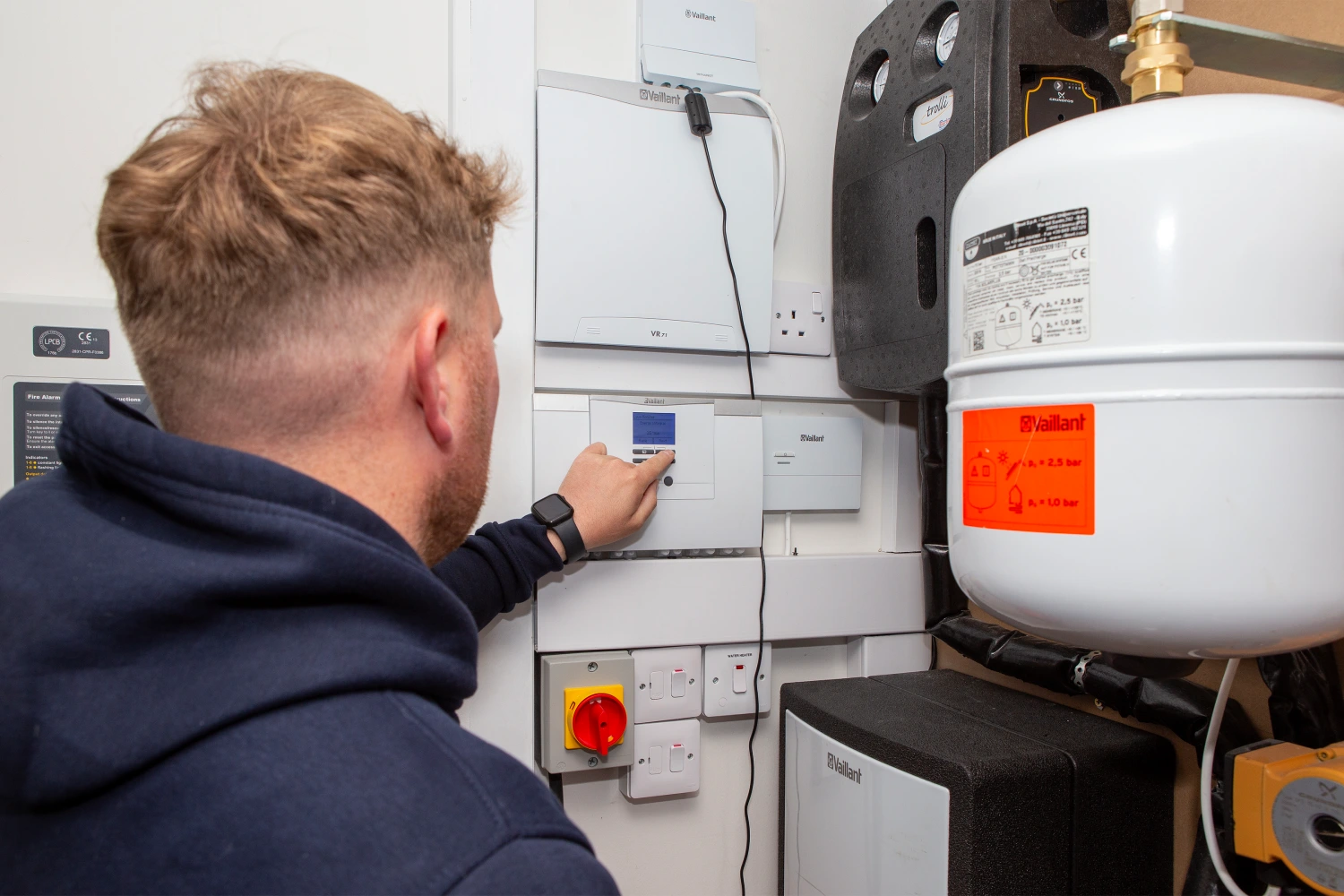
How are the controls set up?
Controls are particularly important because heat pumps can operate differently from conventional boilers.
Rather than rapidly heating a property to a high temperature and then switching off, a heat pump may be designed to operate steadily for longer periods.
The controls need to be configured around the system design and homeowner requirements.
Depending on the equipment, homeowners may have controls for:
- Room temperature
- Heating schedules
- Hot water
- Temperature adjustments
- Holiday periods
- System operating modes
- Weather compensation
A heat pump installation specialist should explain how the controls work and what settings are appropriate for normal operation.
If you are comparing air source heat pump Elgin installations, ask Plumbing & Renewables how the proposed system will be configured and what controls will be included.
Why is hot water part of the heat pump design?
A heat pump may also provide domestic hot water, depending on the system.
This usually means the installation includes a suitable hot water cylinder rather than relying on the same arrangement used by a combination boiler.
The cylinder needs to be correctly sized for the household’s requirements.
Factors such as the number of occupants, bathing habits and hot water demand can influence the appropriate capacity.
The installer should explain where the cylinder will be positioned and how it will integrate with the rest of the heating system.
What happens during commissioning?
Fitting the equipment is only one stage of the installation.
Once the system is connected, the installer needs to commission it and check that the relevant components are operating correctly.
This can involve checking:
- System pressure
- Flow and return temperatures
- Controls
- Heating operation
- Hot water operation
- Electrical connections
- Relevant safety functions
- System settings
The precise checks depend on the equipment and manufacturer’s requirements.
Commissioning is important because it confirms that the completed installation is ready for normal operation.
How does the installer balance comfort and efficiency?
Good system operation is not simply about reaching the highest possible temperature as quickly as possible.
Heat pumps are generally designed around lower-temperature, steady heating.
The installer therefore needs to configure the system so that it can provide the required comfort without relying unnecessarily on high flow temperatures.
This may involve appropriate weather compensation, heating curves and control settings where supported by the equipment.
The homeowner also needs to understand how the system is intended to operate.
Changing settings repeatedly without understanding their purpose can make the system harder to manage.
What happens during the handover?
The handover gives the homeowner the opportunity to learn how to operate the new system.
A useful handover should cover:
- Main heating controls
- Hot water settings
- Normal operating behaviour
- Basic fault indicators
- Maintenance requirements
- Warranty information
- Relevant documentation
- Who to contact if support is needed
Do not worry about asking questions during this stage.
If you are unsure why the heating operates for a particular period or how to adjust the hot water schedule, ask the installer to demonstrate it.
A typical Elgin home example
Consider a homeowner in a traditional property with an existing boiler and several older radiators.
During the assessment, the installer identifies that some radiators are unlikely to provide sufficient output at the proposed heat pump flow temperature. Rather than waiting until installation day, the radiator requirements are incorporated into the system plan.
The heat pump, hot water cylinder and controls are then selected around the property’s requirements. Once installed, the system is commissioned and the homeowner receives guidance on operating the controls.
The result is a heating system designed around the property rather than simply adding a new appliance to the existing setup.
What should homeowners ask before installation?
A few straightforward questions can reveal how thoroughly the proposed system has been considered.
Ask:
- How has the heat pump size been determined?
- Have the radiators been assessed?
- What flow temperature is the system designed around?
- Where will the outdoor unit be positioned?
- What hot water cylinder is being proposed?
- Which controls are included?
- What commissioning will be completed?
- What will I be shown during handover?
- Who should I contact if I need help afterwards?
A clear answer to these questions can make the proposed installation easier to understand.
If you are planning an air source heat pump Elgin project, Plumbing & Renewables can discuss the proposed system, equipment and installation requirements with you before you commit.
Final thoughts
An air source heat pump Elgin homeowners choose should be treated as part of a complete heating system rather than an isolated appliance. The outdoor unit, indoor equipment, radiators, hot water system and controls all need to work together.
Good preparation and careful commissioning help turn the equipment into a heating system that is suited to the property and understandable for the homeowner.
Plumbing & Renewables takes a property-focused approach to renewable heating, helping homeowners understand what is involved before installation and what to expect once the system is commissioned. For anyone considering a heat pump, asking detailed questions at the planning stage can provide greater confidence in the finished system.
Related articles

Which option best describes your home?
At a glance
The system needs to work with the property, existing heating distribution, hot water requirements and controls. Small details in design and setup can influence how evenly the home heats, how the system operates and how straightforward it is to use.
For homeowners considering an air source heat pump Elgin installation, understanding how the system is set up can help explain why a proper property assessment is so important.
If you are considering renewable heating and want to understand how a heat pump could work with your property, contact Plumbing & Renewables for practical, property-specific guidance.
What does a heat pump installer assess before fitting the system?
The setup starts well before installation day.
A suitable installer needs to understand the heating requirements of the property rather than simply choosing a heat pump based on floor area.
The assessment may consider:
- Property size and layout
- Room-by-room heat requirements
- Insulation levels
- Windows and external doors
- Existing radiators
- Pipework
- Hot water demand
- Electrical requirements
- Outdoor unit location
- Available space for indoor equipment
This information helps determine what equipment is appropriate and whether changes to the existing heating system are required.
A heat pump installation specialist should be able to explain the reasoning behind the proposed system rather than simply presenting a standard package.
How is the heat pump sized for the property?
Sizing is one of the most important parts of the design process.
A heat pump needs to provide enough heat to meet the property’s requirements under appropriate conditions. Selecting a system that is too small or poorly matched to the home can create problems with comfort and system operation.
At the same time, simply choosing a larger unit is not automatically better.
The aim is to select equipment that is appropriate for the calculated heating demand and intended operating conditions.
This is why a proper assessment is more useful than relying solely on a generic online calculator or property size.
Why do radiators matter with an air source heat pump?
Existing radiators form part of the overall heating system, so they need to be assessed alongside the proposed heat pump.
Heat pumps generally operate at lower flow temperatures than many traditional boilers. As a result, a radiator that worked well with a high-temperature boiler may not necessarily provide the same heat output under heat pump operating conditions.
Some existing radiators may be perfectly suitable.
Others may need to be upgraded or replaced with larger models.
The important point is that this should be established during the design stage, rather than discovered after installation.
Which option best describes your home?
It just takes 2 minutes
And then you can book a free consultation
How does the outdoor unit contribute to home comfort?
The outdoor unit extracts heat from the surrounding air and transfers it into the home’s heating system.
Its position therefore needs to be carefully considered.
Installers may need to look at:
- Available space
- Airflow around the unit
- Access for maintenance
- Pipework routes
- Electrical connections
- Drainage
- The manufacturer’s installation requirements
The outdoor unit should not simply be placed wherever there happens to be an empty section of wall or garden.
Its location forms part of the wider system design.
What happens to the heat once it enters the home?
The heat pump transfers heat into the home’s heating system, which then distributes it through radiators or other heat emitters.
The overall system can include several connected elements:
| Component | Main purpose |
| Outdoor heat pump | Extracts heat from outdoor air |
| Indoor hydraulic components | Transfer and manage heat within the system |
| Radiators or emitters | Deliver heat into rooms |
| Hot water cylinder | Stores heated domestic hot water |
| Controls | Manage temperatures and operating schedules |
| Pipework | Circulates water between components |
Each component needs to work with the others.
This is why system design matters as much as the individual heat pump model.
How are the controls set up?
Controls are particularly important because heat pumps can operate differently from conventional boilers.
Rather than rapidly heating a property to a high temperature and then switching off, a heat pump may be designed to operate steadily for longer periods.
The controls need to be configured around the system design and homeowner requirements.
Depending on the equipment, homeowners may have controls for:
- Room temperature
- Heating schedules
- Hot water
- Temperature adjustments
- Holiday periods
- System operating modes
- Weather compensation
A heat pump installation specialist should explain how the controls work and what settings are appropriate for normal operation.
If you are comparing air source heat pump Elgin installations, ask Plumbing & Renewables how the proposed system will be configured and what controls will be included.
Why is hot water part of the heat pump design?
A heat pump may also provide domestic hot water, depending on the system.
This usually means the installation includes a suitable hot water cylinder rather than relying on the same arrangement used by a combination boiler.
The cylinder needs to be correctly sized for the household’s requirements.
Factors such as the number of occupants, bathing habits and hot water demand can influence the appropriate capacity.
The installer should explain where the cylinder will be positioned and how it will integrate with the rest of the heating system.
What happens during commissioning?
Fitting the equipment is only one stage of the installation.
Once the system is connected, the installer needs to commission it and check that the relevant components are operating correctly.
This can involve checking:
- System pressure
- Flow and return temperatures
- Controls
- Heating operation
- Hot water operation
- Electrical connections
- Relevant safety functions
- System settings
The precise checks depend on the equipment and manufacturer’s requirements.
Commissioning is important because it confirms that the completed installation is ready for normal operation.
How does the installer balance comfort and efficiency?
Good system operation is not simply about reaching the highest possible temperature as quickly as possible.
Heat pumps are generally designed around lower-temperature, steady heating.
The installer therefore needs to configure the system so that it can provide the required comfort without relying unnecessarily on high flow temperatures.
This may involve appropriate weather compensation, heating curves and control settings where supported by the equipment.
The homeowner also needs to understand how the system is intended to operate.
Changing settings repeatedly without understanding their purpose can make the system harder to manage.
What happens during the handover?
The handover gives the homeowner the opportunity to learn how to operate the new system.
A useful handover should cover:
- Main heating controls
- Hot water settings
- Normal operating behaviour
- Basic fault indicators
- Maintenance requirements
- Warranty information
- Relevant documentation
- Who to contact if support is needed
Do not worry about asking questions during this stage.
If you are unsure why the heating operates for a particular period or how to adjust the hot water schedule, ask the installer to demonstrate it.
A typical Elgin home example
Consider a homeowner in a traditional property with an existing boiler and several older radiators.
During the assessment, the installer identifies that some radiators are unlikely to provide sufficient output at the proposed heat pump flow temperature. Rather than waiting until installation day, the radiator requirements are incorporated into the system plan.
The heat pump, hot water cylinder and controls are then selected around the property’s requirements. Once installed, the system is commissioned and the homeowner receives guidance on operating the controls.
The result is a heating system designed around the property rather than simply adding a new appliance to the existing setup.
What should homeowners ask before installation?
A few straightforward questions can reveal how thoroughly the proposed system has been considered.
Ask:
- How has the heat pump size been determined?
- Have the radiators been assessed?
- What flow temperature is the system designed around?
- Where will the outdoor unit be positioned?
- What hot water cylinder is being proposed?
- Which controls are included?
- What commissioning will be completed?
- What will I be shown during handover?
- Who should I contact if I need help afterwards?
A clear answer to these questions can make the proposed installation easier to understand.
If you are planning an air source heat pump Elgin project, Plumbing & Renewables can discuss the proposed system, equipment and installation requirements with you before you commit.
Final thoughts
An air source heat pump Elgin homeowners choose should be treated as part of a complete heating system rather than an isolated appliance. The outdoor unit, indoor equipment, radiators, hot water system and controls all need to work together.
Good preparation and careful commissioning help turn the equipment into a heating system that is suited to the property and understandable for the homeowner.
Plumbing & Renewables takes a property-focused approach to renewable heating, helping homeowners understand what is involved before installation and what to expect once the system is commissioned. For anyone considering a heat pump, asking detailed questions at the planning stage can provide greater confidence in the finished system.